What Age Is Safe for Baby to Take Theatre
ask an good
Is It Safe to Go to a Movie theatre Right Now?
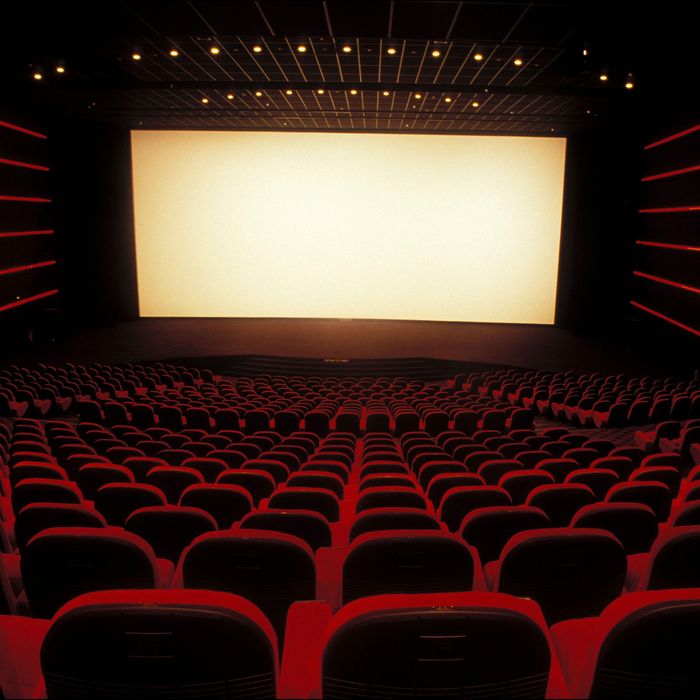
Dr. Robert Lahita attempts to answer all of our questions about cinema'southward grand reopening this August. Photo: Alain Benainous/Gamma-Rapho via Getty Images
This piece has been updated with new information apropos nationwide plans to reopen picture theaters this summer.
When we last checked in with our public-wellness expert on the safe of returning to theaters in the midst of the coronavirus outbreak, his outlook was bleak: "It'southward like Russian roulette," he said. "You never know."
That was in late June. The major theatrical bondage were planning to reopen the following calendar month, in fourth dimension to lure moviegoers dorsum with the double-whammy releases ofMulan and Tenet, then slated for late-July openings. Only those plans were scuttled as COVID-19 continued to spread across the land, and the death toll rose. Since so, Disney has moved Mulan to its streaming platform, Warner Bros. has rescheduled (and re-rescheduled) Tenet's debut appointment, and cineplexes in many states have remained closed. AMC finally began the staggered reopening of its locations Thursday, with Regal and Marcus Theaters following suit Friday; all are hoping to have significant screens bachelor for Tenet'south American rollout, which is now scheduled to begin Labor Twenty-four hours weekend.
So I again rang up Dr. Robert Lahita, chairman of medicine at St. Joseph's Health in New Jersey, professor of medicine at New York Medical Higher, and offshoot professor of medicine at Rutgers, to talk over whether or not nosotros should be rushing to the box office this calendar week.
"Nosotros've seen 30,000 new cases popping upwards in the southern states and the Sunbelt," Lahita told us back in June. "Information technology seemed there was a flattened curve, so all of a sudden, nosotros're going upwardly once more. So these guys are going to open up theaters when we have an increase of infections?"
Concern over rising infection rates aside, Lahita believes basic safety measures — including socially distanced reserved seating, frequent cleaning of screening rooms, and temperature checks at the Cineplex door — will go a long way for those attempting a return to the theater. "There's ever an inherent risk, but I was actually surprised at how thorough some of the planning is," Lahita adds of the broad strategies he's seen.
The chains' initial reluctance to require confront masks on all guests, even so, had Lahita concerned. "You'd have to be nuts" not to wear a mask, he says. "Yous're with a group of strangers. Unless you're sitting twenty or 30 feet from the other person, you run the risk of being infected. There's no question about it. Yous know how the air is in a theater: It's non circulated very well. If you don't wearable a mask, you have your chances."
Thankfully, AMC and Regal reversed grade, announcing that guestswould be required to wear masks — though their present policy allows for masks to be removed while eating and drinking concessions.
Lahita works in New York and New Jersey, which are not among united states of america where the chains will open up their doors this calendar week, since their governors take explicitly excluded movie theaters from reopening. Though New York'southward positivity rate has remained below one percentage for well-nigh 2 weeks, and the country and New York Metropolis are well into phase four, Governor Andrew Cuomo has kept theater doors closed, noting that "on a relative adventure scale, a pic theater is less essential and poses a loftier take a chance. It is congregant. Information technology is one ventilation organization. Yous are seated in that location for a long period of fourth dimension. Even if you are at l pct capacity with ane or two seats between the two of you, this is a take a chance situation and … movie theaters are not that loftier on the list of essentials."
"It is not an essential locale," Lahita agrees. "Merely when people want to be entertained, they want to go to the theater, that's their business," he says, adding, "If you're going to practise phase four opening of essentially nonessential locales such every bit restaurants, gyms, tattoo parlors, and barbershops, I would think those would be of more run a risk than going to a pic theater, because of their inherent proximity to strangers."
"That's comparable to [eating from] a buffet in a restaurant," Lahita said dorsum in June. "There'south an interchange of money, y'all put your hands on the counter, you wait to get the popcorn and the soda and all that." Though some theaters will employ contactless methods for concession transactions, and others will not offer condiment stations, there is nevertheless the result of masks — and the need to take them off to swallow food and potable.
But Lahita notes that as long as theaters are enforcing reduced capacities and social-distancing measures, with empty rows and empty seats between parties, eating in a theater might not be every bit dangerous as you retrieve. "The servers should be wearing a mask, no question about information technology," he says. Just provided the moviegoer takes their popcorn and soda to their seat and waits until they're settled in the uniformly facing chairs to move or remove their mask, they should be fine. "Unless yous're being coughed or sneezed on past the person backside you, or the children next to you, I don't encounter whatsoever major hazard."
Some theaters (specially the Alamo Drafthouse), in an endeavour to bound-start acquirement, take fabricated their auditoriums bachelor for private screenings, wherein minor groups can rent a theater and a selection of films for a set up fee (and minimum food buy). Lahita thinks this is a smart option for wary would-exist moviegoers.
"If you rent the theater out for you and your friends," he says, "and you've got a 300-seat theater and there's only v of y'all out in that location, wow, that's like being in a ballpark. You lot don't accept to worry at that place. And you lot know your friends, presumably, right? You lot know who is and isn't infected."
As the theatrical lockdown wore on over the past several months, drive-in picture show theaters have thrived, offering audiences a way to "go to the movies" while even so remaining in a safe, socially distanced chimera. (Sadly, there aren't that many left to frequent; well-nigh drive-ins were put out of business organization in the 1970s and '80s past the very multiplexes that are now locked up.)
"It is perfectly safe, provided y'all practise not get out your automobile," Lahita said in June. "Y'all would have to stock your auto with food and drink. And you would accept to leave the auto to become to the bathroom, which of course exposes y'all to risk. In the summer you would take to leave the windows down, or keep the engine running for air conditioning. With windows down, your neighbor could infect you, although that'south unlikely."
Theaters like AMC and Cinemark accept promised copious sanitizer distribution throughout their buildings, merely Lahita warns that handwashing volition remain necessary. "If you touch annihilation in the restroom, like the handle, the toilet, the urinal, you wipe your hands down and launder your hands after going to the bathroom," Lahita adds. "Make sure you launder them thoroughly with soap and h2o, and everything should be fine."
In promoting their pending reopenings, theaters have made much of their "intensified cleaning protocols." But as surface transmissions take proven rare, some of this amounts to what The Atlantic'southward Derek Thompson dubbed "hygiene theater": "risk-reduction rituals that make the states feel safer but don't actually practise much to reduce hazard — even as more dangerous activities are all the same allowed." Does some of this fall into that category?
"Between movies, where they run around and pick upwardly the garbage, I remember if they accept some aerosolization sprays and spray the seats and stuff, that'due south fine." Lahita says. "But you're admittedly correct, there's no major evidence that yous're going to selection upward the virus from touching a pew in a church or a chair in the theater at this fourth dimension. I don't remember that's a realistic worry. We used to worry nearly that, but we've learned that the virus doesn't alive very long on these things. So betwixt shows, disinfection is the fashion to get, but I don't recall during the bear witness you accept to run effectually and spray everybody."
So, as before, Lahita advises bringing disinfecting wipes and wiping downwardly your firsthand seating area before settling in for a picture show — with one update: Back in March, he noted that plastic seats were much more cleanable with wipes — and thus safer — than their textile counterparts. "The data now shows that cloth seats and plastic seats don't make a difference," he explains. "In fact, I think there was some data suggesting that fabric seats were really better than plastic and metal. The virus doesn't live for very long on whatsoever of these fomite kind of things. You tin wipe plastic down, y'all tin't wipe cloth down, simply material is non likely to be equally infected; neither is plastic according to the information I've seen. So that'south not a large concern."
When discussing the various logistical details of a movie house reopening, you lot might discover yourself asking a bigger question: Are theater owners acting responsibly past reopening their doors, fifty-fifty at limited capacity, when infection is still a risk? Are studios acting responsibly by putting out new movies, with the hope that patrons will take a chance their health to see them in theaters?
"That's a real doozy of a question," Lahita admitted in June, "considering, you know, my criticism and concern right now is that these mass gatherings in Florida, in Arizona, New Mexico, and in California — people are gathering on beaches and things without masks and no social distancing. Is this pushing it? Well, I don't desire to see the movie industry die. But on the other manus, if I were them, I would prolong the release of new movies until, say, the autumn because there could be a resurgence of this virus in September, October when the temperatures modify again in the Northeast. So if everybody'due south going to the movies, information technology could spike reinfection rates."
But there are no easy answers, he insists. "I would say 70 percent of the people [infected with COVID-nineteen] are not-symptomatic, or if they get the illness, they're sick, just they recover at home. There'southward that minor percent that's of not bad concern. We don't know who they are and we accept no fashion to make up one's mind who they are, and then that'southward the scary part."
Every bit the staggered reopening of bondage begins — with Cuomo indicating that theaters "should be next" to reopen in New York — many moviegoers will soon be faced with the question of whether information technology's worth risking one's wellness to go back to the multiplex, no matter how desperately they might want to see Tenet. But Lahita feels that as long as theaters employees and moviegoers are acting responsibly, it can be done.
"We tell them to wear a mask, we continue social distancing, you lot tin can buy food — only don't eat the nutrient until you go into the theater," Lahita advises. "[Family members] tin can sit down next to you because you're with them all the time and you know their health state of affairs. But the [other] people in the theater should exist at least two rows apart."
"Nothing is 100 percent safety," Lahita adds. "Just I would say you're 95 percent safe if y'all go to the movies [with all of the stated measures in place]. I don't know near alive theater, because the seating there is a petty closer than in a big picture theater, and that could be a little dicey. Plus, the people onstage are screaming, yelling, singing … This may actually be the showtime time that orchestra seats are not a expert idea."
Merely if you go without a mask? "Information technology's like Russian roulette. You never know."
We're committed to keeping our readers informed.
We've removed our paywall from essential coronavirus news stories. Go a subscriber to support our journalists. Subscribe now.
What Age Is Safe for Baby to Take Theatre
Source: https://www.vulture.com/2020/08/is-it-safe-to-go-to-a-movie-theater-during-coronavirus.html
0 Response to "What Age Is Safe for Baby to Take Theatre"
Post a Comment