Why Go to the Moon Again
Artemis one: Going back to the moon
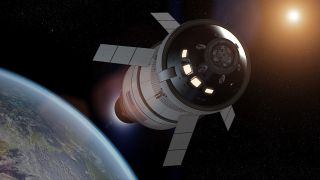
The Artemis 1 mission will marker a big step in humanity'south return to the moon.
2022 marks half a century since Apollo 17 astronaut Eugene Cernan left the last footprints on the moon in 1972, and a lot has changed since then.
That twelvemonth, the get-go scientific hand-held calculator was released; today nosotros carry more computing power in our pocket than that which safely guided the Apollo astronauts to the moon and back.
Now, at long terminal, humanity is about to leave low World orbit (LEO) once again. Merely ii dozen astronauts accept achieved that feat then far, all of them white men. Soon the first female astronaut and offset astronaut of color volition join the lauded lists of moonwalkers. It's all thanks to the Artemis program , NASA's plan to explore more of the lunar surface than always earlier.
By 2025, we could see astronauts walk in the lunar grit again, with the upgrade from grainy black and white video footage that half a century of technological progress has brought. A whole new generation could meet themselves as budding space travelers, inspired to dream large.
But pulling off this next moonshot requires an entirely new launch system and a bit of practice first.
Related: Every mission to the moon
The Space Launch System rocket
The uncrewed Artemis 1, which is expected to launch in May or June 2022, volition mark the debut of NASA'southward huge Infinite Launch System (SLS) rocket.
The new megarocket volition send the Orion capsule on a roughly 4-calendar week journeying around the moon. If all goes according to plan, the Artemis two mission volition follow in 2024, sending astronauts around the moon and dorsum.
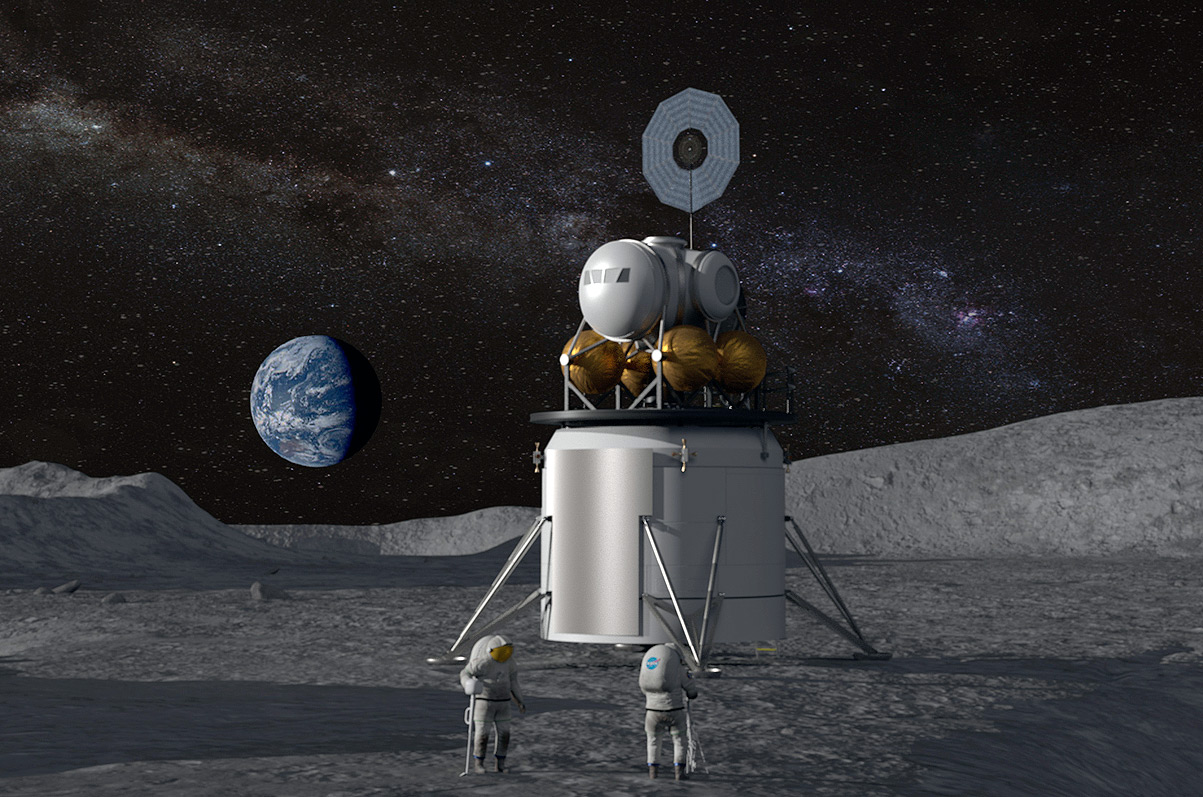
Artemis iii will put astronauts down on the moon, near the lunar south pole, with the assist of SpaceX's Starship vehicle. This landmark mission is targeted for 2025 or 2026.
Even without a crew, Artemis one will be a tape-billow. Co-ordinate to NASA, "Orion will stay in space longer than whatsoever ship for astronauts has done without docking to a infinite station and return home faster and hotter than e'er before."
But outset Orion has to leave Globe.
Ii huge solid rocket boosters and a core stage filled with 733,000 gallons (ii.viii million liters) of propellant will power Orion through Earth's atmosphere to orbit. The SLS upper phase, known as the Interim Cryogenic Propulsion Stage (ICPS), will then fire to ship Orion toward the moon.
In one case the ICPS has fired, it has another job: to deploy 10 tiny cubesats that are hitch-hiking aboard Artemis 1. These little spacecraft include BioSentinel, a mission that will carry yeast samples beyond LEO. The idea is to report radiation levels and their effect on living organisms, which will provide cardinal insights in keeping astronauts safe when they fly on future Artemis missions.
Later on separation from the ICPS, Orion will exist propelled and powered by the European Service Module, built by the European Infinite Agency (ESA). "The Service Module will also provide consumables for future coiffure, including water and oxygen," said Phillippe Berthe, ESA'southward project coordination manager for the module.
Artemis 1 may non take a man crew on board, only the commander's seat will be occupied past a mannequin dressed in the Orion Crew Survival Organisation, a special accommodate designed to help protect confronting radiation. Two radiation sensors will monitor radiation levels during the flight.
The mannequin will be strapped in, merely the weightless surround also needs testing. And so NASA is flying a "zero gravity indicator" in the form of a Snoopy cuddly toy dressed in an iconic orange NASA jumpsuit. The comic strip character has a long clan with lunar exploration; the coiffure of Apollo 10 nicknamed their lunar module Snoopy.
So how does the new Orion service module compare to the lunar modules that sent Apollo astronauts to the moon? "The propulsion is largely the same; it is very comparable to the Apollo era," said Berthe. Yet one-half a century of technological progress has brought other strides forrad. "There have been vast improvements in solar cells," Berthe said.
"Computing power is another major improvement," said Berthe. The Apollo astronauts famously flew to the moon with less computing power than institute in an iPhone. That meant a lot of manual tasks for the crew. This time effectually, the spacecraft's powerful computers can exercise nigh of the heavy lifting.
"We can program much more circuitous operations at present. The crew don't need to arbitrate straight in every nitty-gritty detail," Berthe said.
The Artemis ane flight plan
Artemis 1 volition be gone for between 26 and 42 days. Information technology'll take ane to ii weeks to get to the moon, where Orion volition swoop down close to the lunar surface and utilise the gravitational boot it receives to enter a and so-chosen "distant retrograde orbit."
Retrograde means that it will orbit the moon in the opposite direction to that in which the moon spins. Orion volition stay in that orbit for between vi and 19 days. Then it will swing back down toward the moon for another boot to assist power its ix- to xix-mean solar day journey back to Earth.
This project has been a labor of love for Berthe, who has been involved with information technology for nearly two decades and has seen many obstacles come up and go.
"One of the biggest challenges has been maintaining support beyond iv administrations," he said.
The administrations of the U.S. presidents Bush-league, Obama, Trump and Biden have all put their own spin on the nation'due south homo spaceflight program, shifting NASA'southward focus from the moon to an asteroid and then dorsum to the moon once more over the years.
Artemis timelines have too moved around; President Trump targeted 2024 for the programs' first crewed lunar landing, for example.
"The mission has changed a lot of times," Berthe said.
On top of the politics came the coronavirus pandemic, which certainly didn't assist . But Berthe said the pandemic didn't have equally large an bear upon as he had feared. "It was hard for people to cross international borders," he said, noting that complication "somewhat slowed us down."
At that place have also been enough of Artemis naysayers — those who argue that sending humans back to the moon is a waste product of fourth dimension, money and resources. We've already done it, such people say, then why go back, especially since humanity has already sent an armada of robotic spacecraft to both scan the moon from orbit and bulldoze across the lunar surface.
Berthe has an answer for that question.
"An astronaut will practise in a half dozen-hour [moonwalk] what a robot can practice in 6 months," he said. "It is more expensive, but information technology is more efficient."
We ultimately too want more than than but fleeting visits.
"We want to stay permanently and build something sustainable for the long run," Berthe said. Indeed, Artemis aims to establish a sustainable human being presence on and effectually the moon by the terminate of the 2020s, NASA officials have said, stressing that the plan will likewise serve as a steppingstone toward Mars, where the agency wants to transport astronauts in the 2030s.
And Artemis isn't just about the lunar surface; a moon-orbiting outpost called Gateway is a big office of the program. Think of information technology similar an International Infinite Station, but in orbit effectually the moon. A home considerably-farther-away from home. Gateway could exist ready equally before long as November 2024, and it is intended to concluding for 15 years.
While aboard Gateway, astronauts will stay in the Dwelling and Logistics Outpost (HALO). There are also boosted docking ports for cargo ships to come and get with supplies. Astronauts would then transfer to the Starship Human Landing System (HLS), a lunar lander based on SpaceX's existing Starship.
Initially stays volition be short and largely inside the lander, but ultimately NASA wants astronauts living on the lunar surface, at Artemis Base Camp, for at least a month at a time. In September 2021, the agency put out a telephone call for companies to submit their proposals for the next generation of spacesuits that Artemis astronauts will vesture during their history-making moonwalks.
Later Artemis one
Eventually the space between the Earth and the moon could be swarming with spacecraft ferrying goods and astronauts back and along. Jeff Bezos, the founder of Amazon and the spaceflight company Blue Origin, has suggested that the moon could be a place to put our heavy manufacture. Doing so would costless up living infinite on Earth and motility our atmosphere-polluting infrastructure somewhere where there isn't fifty-fifty an temper, the thought goes.
The moon is as well an ideal staging post for deeper solar system exploration, experts say. The size and scale of the SLS shows just how difficult we take to work to escape from Earth'southward gravitational clutches. The moon's gravity, which is six times weaker than ours, is considerably easier to flee from. There are also huge amounts of h2o on the moon. As water is H2O, that means an abundant supply of oxygen. In fact, the moon'south top layer alone has plenty oxygen to sustain 8 billion people for 100,000 years, researchers have calculated. Liquid oxygen is too rocket propellant, so moon mining could lead to the cosmos of off-Earth "gas stations" where voyaging spaceships could fill up upward their tanks.
How rockets work: A consummate guide
That's why Artemis Base Campsite will exist at the moon'due south s pole: We already know that there's plenty of water there. Lunar Flashlight, one of the small spacecraft hitching a ride on Artemis 1, will orbit the moon and shine infrared lasers into permanently shadowed craters near the lunar poles to further reveal the quantity and accessibility of water ice in that location.
The sunlight at the lunar south pole is likewise favorable; it is illuminated approximately 90% of the time, compared to two weeks of daylight followed by 2 weeks of darkness on the rest of the moon. That'southward good news for a lunar outpost powered past solar panels. The combination of these two factors — water and sunlight — may lead to a time when rocket ships routinely fuel up close to Artemis Base Camp and blast off for more distant climes such every bit Mars and the asteroid belt.
Former NASA chief Jim Bridenstine certainly sees lunar exploration as a central step on our journeying toward condign an interplanetary species. He has said that humanity needs "several years in orbit and on the surface of the moon to build operational confidence for conducting long-term work and supporting life abroad from Earth before we can embark on the beginning multi-year human being mission to Mars."
It's all part of returning to where we came from. The iron in your blood and the calcium in your bones was forged inside stars that blasted these elements across the universe when they died. Eventually those atoms found themselves inside sentient creatures who dreamed of sailing between the stars and congenital cathedral-sized rocket ships to take them there.
The Artemis one launch this yr may only be a pocket-size step, but it'south an important one. Future historians could look back on information technology as the moment humanity took a giant jump in its render to the moon, this time for practiced.
Additional resources
For more information nigh the Artemis ane mission and to receive live updates, check out NASA'due south Artemis i webpage. The European Infinite Agency has also put together this blitheness to visualize the mission.
Bibliography
- "Cess of Artemis-1 Evolution Flight Instrumentation," Sensors and Instrumentation, Aircraft/Aerospace, Energy Harvesting & Dynamic Environments Testing, Volume 7, September 2020, https://doi.org/10.1007/978-3-030-47713-4_4
- Marshall Smith et at, "The Artemis Plan: An Overview of NASA's Activities to Return Humans to the Moon," IEEE Aerospace Conference, pp. 1-10, March 2020, https://doi.org/x.1109/AERO47225.2020.917232
- John Honeycutt. "NASA's Infinite Launch System: Progress Toward Launch," Session: On-Globe Spaceports and Launch Systems, November 2020, https://doi.org/10.2514/vi.2020-4037
Follow usa on Twitter @Spacedotcom or on Facebook .
Join our Space Forums to go on talking infinite on the latest missions, dark heaven and more! And if yous take a news tip, correction or comment, let us know at: customs@space.com.
Source: https://www.space.com/artemis-1-going-back-to-the-moon#:~:text=He%20has%20said%20that%20humanity,to%20where%20we%20came%20from.
0 Response to "Why Go to the Moon Again"
Post a Comment